
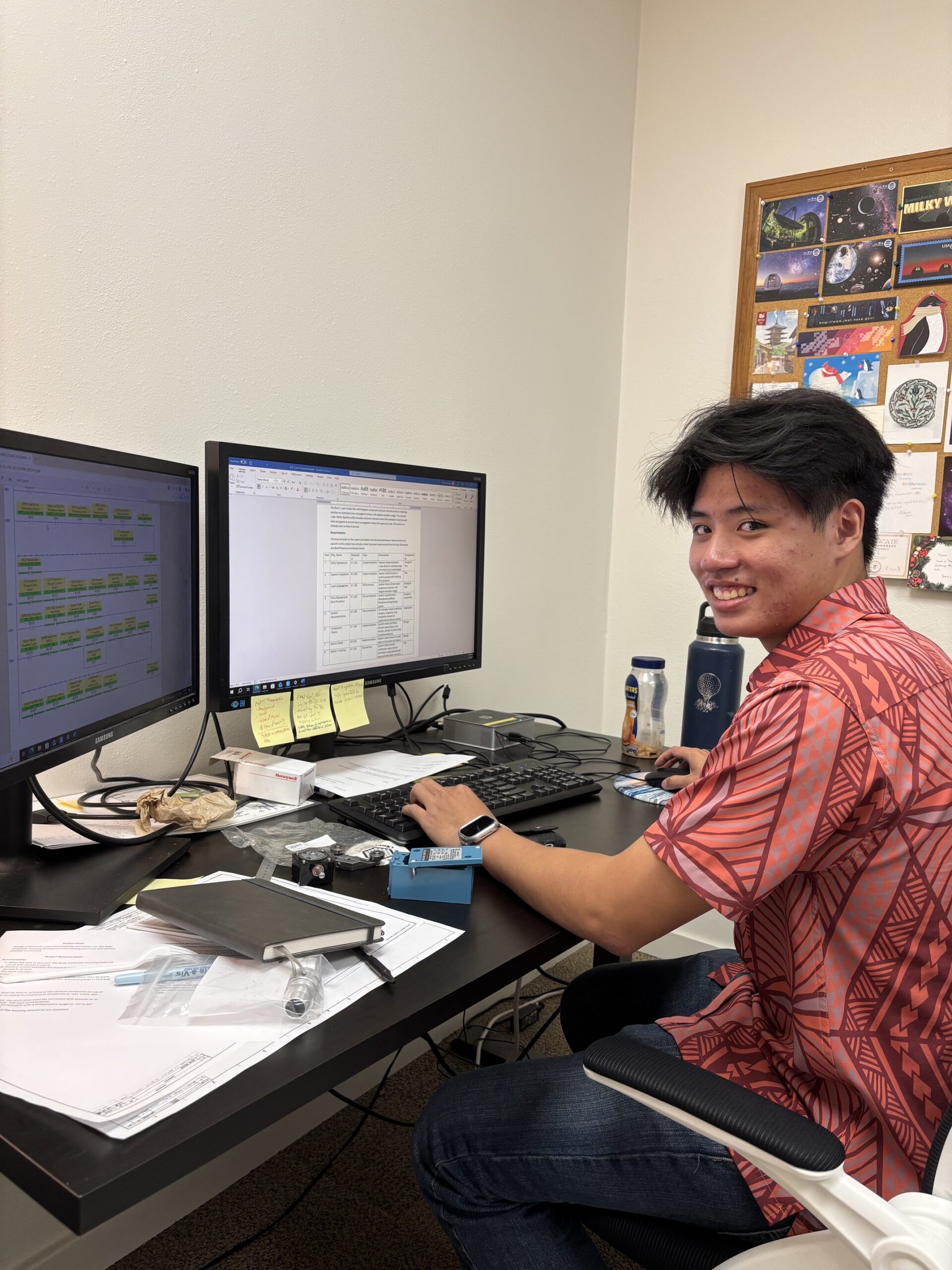
Edinn was born and raised in Hilo, Hawaii, where he
graduated from Waiakea High School. He is currently
attending the Pre-Engineering program at the University of
Hawaii at Hilo and intends to complete his degree at the
University of Hawaii at Manoa in Electrical Engineering. He
is currently a part of the ?Alal? conservation project,
where he is assisting with the development of a bird
feeder to help in the release of the ?Alal?. After
graduating, he hopes to continue to help local
communities with his knowledge and innovate for a
sustainable future in Hawaii.
Home Island: Hilo, Hawaii Island
High School: Waiakea High School
Institution when accepted: UH Manoa
Site: W. M. Keck Observatory (Keck). Waimea, Hawaii Island
Mentors: Ed Wetherell
Project title: Implementing an Elevation Interlock for Keck I’s Telescope Laser
Project Abstract:
The Keck I Telescope on Mauna Kea utilizes a laser guide star to assist in data collection specifically
for adaptive optics during observing periods. The laser can propagate anywhere in the sky, but has
to be restricted to above a 25-degree elevation angle for safety regulations. The current Laser Safety
System (LSS) includes a software interlock, but lacks a hardware interlock to fulfill these
restrictions. The goal of this project will be to integrate a hardware interlock for Keck I’s laser guide
star as a backup solution to eliminate laser propagation below a 25-degree elevation angle. Having a
hardware interlock provides a safety fault that relies only on elevation angle, whereas the software
interlock has different variables it accounts for to provide a permissive for the laser. This system
shall allow the existing range of motion of the telescope to be unchanged, as well as interface with
the existing Programmable Logic Controller (PLC) program that holds the software interlock. In the
event of a failure, this system shall also come to a safe state to prevent further harm. Logs and
documentation will also be provided and organized as required. The hardware interlock is split into
two parts: a striker and a switch. The striker is mounted on the elevation ring. The switch is located
on the right Nasmyth platform. Through various testing methods, the hardware interlock was
installed and met the goal of eliminating laser propagation below a 25-degree elevation angle and is
now pending approval from telescope operations staff.