
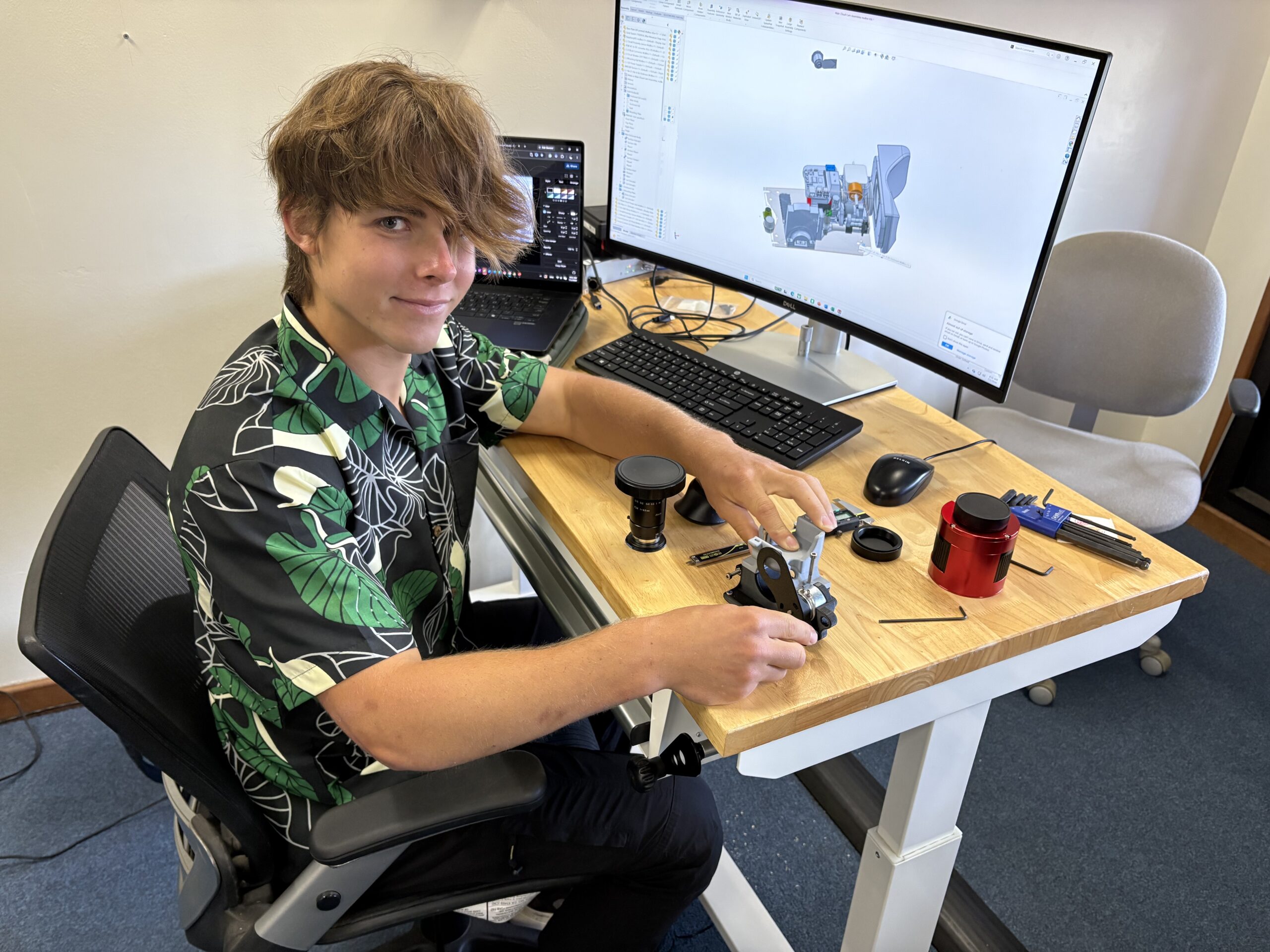
Ira Mullins was born and raised on the Big Island of Hawaii.
After graduating from Keaau High School, he is currently
pursuing a degree in mechanical engineering at the Colorado
School of Mines. His interest in engineering was sparked by
his middle school science teacher, Mr. Wells, at the Volcano
School of Arts and Sciences. Ira hopes to use the knowledge
gained from his engineering education to develop
technologies that help mitigate and de-escalate the
challenges facing the modern world. Outside of engineering,
Ira enjoys backpacking, rock climbing, snowboarding, and
spending time outdoors. He is currently a member of Hike for
Help, the Mines Alpine Club, and Mines Slacklining.
Home Island: Hilo, Hawaii Island
High School: Keaau High School
Institution when accepted: Colorado School of Mines
Site: Canada–France–Hawaii Telescope (CFHT). Waimea, Hawaii Island
Mentors: Marc Baril
Project title: Development of a Weatherproof Enclosure and Refocusing Mechanism for CFHT’s Upgraded Cloud-Cam
Project Abstract:
The Canada-France-Hawaii Telescope (CFHT) is a world-class astronomical observatory operating
on Maunakea, Hawai?i. Remote observers operating CFHT require accurate weather data to ensure
its safe operation and the proper sequencing of observations. Two high-sensitivity cameras,
referred to as the Cloud Cams, provide real-time views of the night sky, allowing observers to detect
oncoming clouds and fog. The current Cloud Cams are being upgraded to improve reliability as well
as increase resolution and field of view. This project focused on the mechanical implementation and
integration of these new Cloud Cams. The design includes a mechanical shutter, focusing system,
and waterproof enclosure. Component mounting systems were designed for fast and intuitive
assembly and disassembly. To simplify future fabrication of additional cameras, emphasis was
placed on low-cost manufacturing techniques. SolidWorks was utilized for computer-aided design,
and 3D-printed PLA was employed to prototype custom components. After an iterative design cycle
that validated all conceptual ideas, final fabrication was completed in-house using glass
fiber–reinforced ABS and PETG prints, along with resources from CFHT’s on-site machine shop.
Mechanical integration is sufficiently complete that electrical and software integration can proceed.
The Cloud Cam will then be tested at CFHT’s headquarters in Waimea prior to installation on
Maunakea.